
Clothing is more than just fabric; it is a reflection of a society’s culture, climate and beliefs. Tamil Nadu, with its rich heritage, provides an intriguing lens to explore how clothing practices have evolved over centuries. From the early drapes of the Sangam period to the tailored influences of colonial rule, Tamil clothing tells a vibrant story of adaptation and resilience.
Historical Evidence of Early Tamil Clothing
Textiles, being perishable, leave behind little direct evidence in the archaeological record. Yet scholars have managed to piece together the story of ancient Tamil clothing through literary references, sculptural depictions, and occasionally, preserved fabric fragments that have survived the ravages of time.
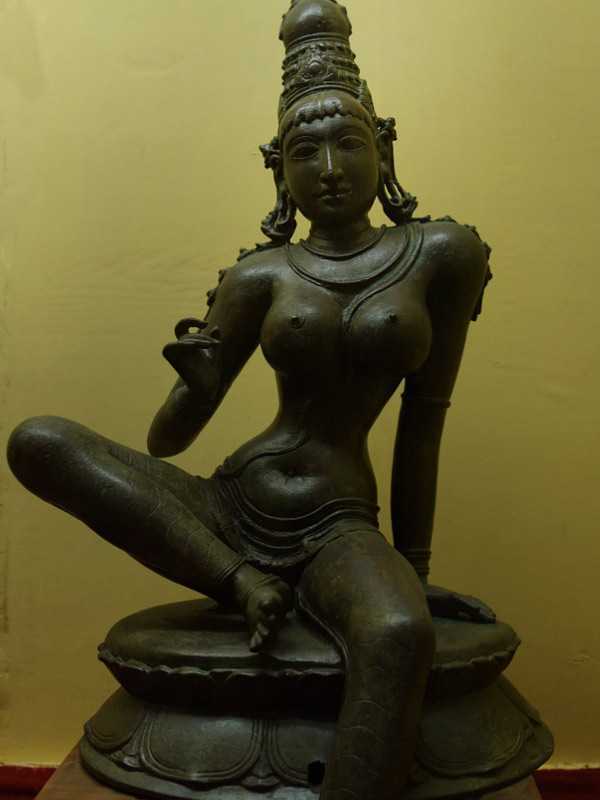
Parvati, Chola bronze, Tamil Nadu, 14th century | Depicting bare breasts with no upper clothing | Collection: Saraswati Mahal Art Gallery, Thanjavur.
Textiles, being perishable, leave behind little direct evidence of ancient clothing styles. As a result, our understanding of early Tamil attire comes primarily from literary works, sculptures and paintings. Excavations at sites like Adichanallur (ஆதிச்சநல்லூர்), Arikamedu(அரிக்கமேடு) and Kodumanal(கொடுமணல்) have, however, provided glimpses into the weaving practices of ancient Tamils. Artefacts such as iron and terracotta spindles, spindle whorls and charred fragments of cloth suggest that weaving was a well-developed craft. The oldest direct evidence of ancient Tamil clothing includes a 3,000-year-old cotton fabric from Kodumanal and silk threads from Thirukaambuliyur (திருக்காம்புலியூர்) highlighting the existence of weaving skills during that period.
Dr. K. Rajan, who conducted excavations at Kodumanal, unearthed numerous artefacts that demonstrated the Tamils' expertise in weaving. The findings at the site reveal that Kodumanal was an industrial hub, with facilities for producing shell bangles, a steel smelting factory, a bead polishing workshop and a weaving mill. A half-burnt piece of cotton fabric found at the site, woven with thick threads, is believed to have survived due to cremation practices. It is possible that this fragment escaped complete incineration during the cremation process, allowing it to endure for thousands of years as an important artefact . Remarkably, this fragment, dating back over 3,000 years, offers tangible evidence that the Tamils were familiar with cotton and weaving techniques. Discovered by Dr. Rajan, its survival through cremation rituals provides a rare glimpse into the textile traditions of that era.
Middle-aged Tamil woman in a saree, adorned with big earrings.
உண்பது நாழி, உடுப்பவை இரண்டே (புறம்: 189)
The Purananooru verse illustrates that both men and women in ancient Tamil Nadu wore a two-piece garment. While one piece was draped around the waist, the upper body was covered loosely, often leaving much of it exposed, reflecting the dressing norms of the time when partial or full exposure of the upper body was culturally unremarkable. This style of unstitched clothing, worn loosely, was gender-neutral, highlighting the simplicity and practicality of the attire. The garment’s draping style, however, was not uniform; it varied based on factors such as caste and the local climate.
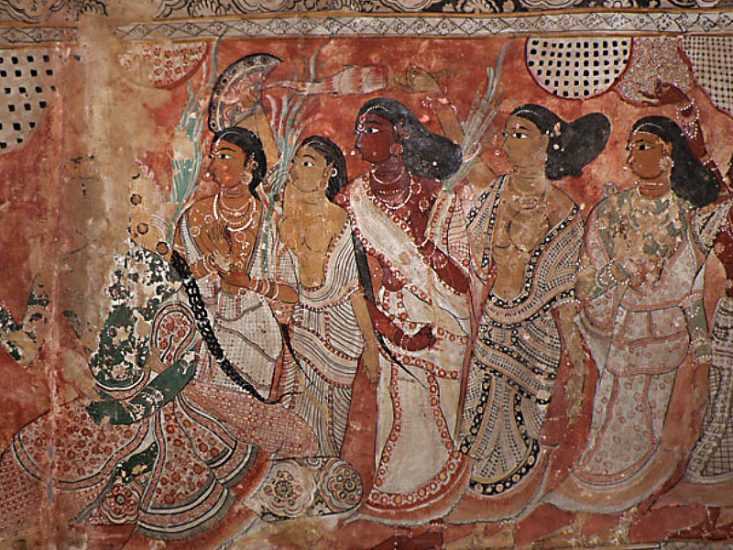
Murals at Veerabhadra Swamy Temple, Lepakshi | Figures with loosely wrapped upper garments | Breasts partially or fully exposed.
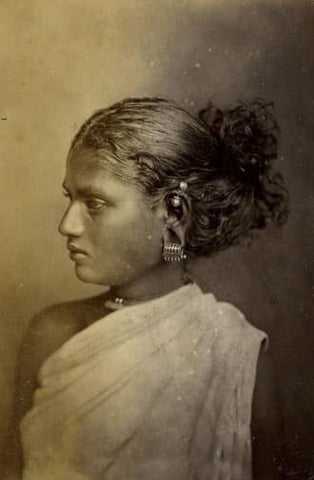
Literary works provide descriptions of clothing styles, mentioning garments like kalingam (கலிங்கம்), kachu(கச்சு), aruvai(அறுவை), thazhai (தழை), sithaar(சிதார்), thukil(துகில்), pattu(பட்டு) which were worn by both men and women. Sculptures and temple carvings suggest that women often left the upper body bare or lightly covered with a shawl, complemented by ornate jewelry.
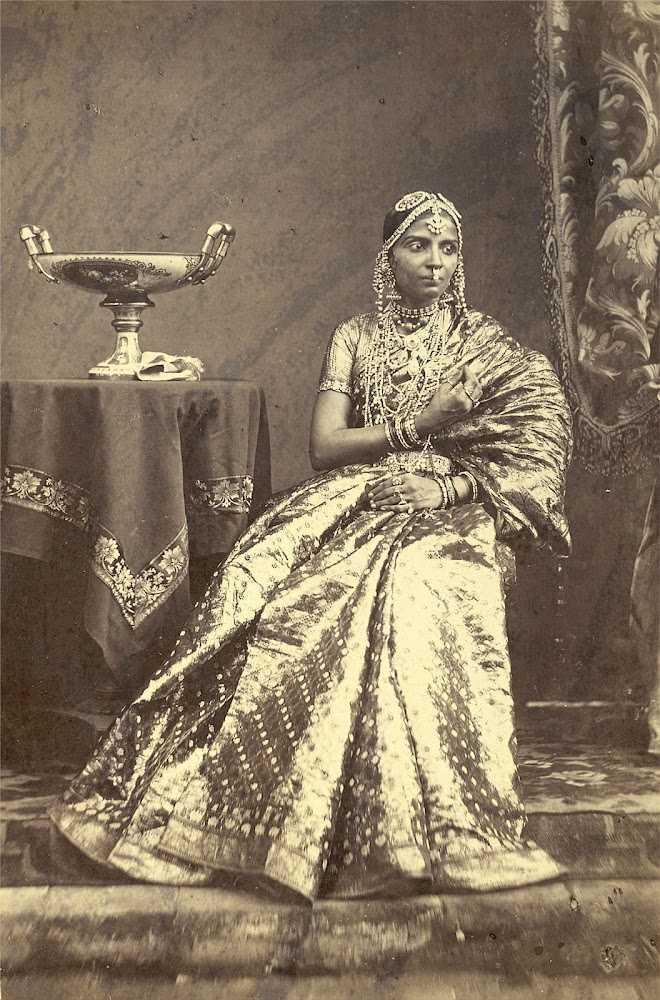
Portrait of a girl wearing jewelry from Madras, 1872 | Jewelry dominates the clothing | Image sourced from the British Library, London Universal Museum.
Women in ancient Tamil society primarily wore garments woven from naturally biodegradable materials such as neithal (நெய்தல்), aambal(ஆம்பல்), nochi(நொச்சி), kuvaLai(குவளை), which were made from flowers, leaves, and shoots.
தழையோர் கொய்குழை அரும்பிய குமரி ஞாழல் (நற்றுனை)
Historian Nivedita Louis notes that these thazhaiyaadai(தழையாடை) were commonly worn during festivals, sports and even while bathing in water bodies, reflecting both their cultural significance and practical use in daily life.
சோறமை வுற்ற நீருடைக் கலிங்கம்... (மதுரைக்காஞ்சி)
This verse mentions that a cloth called Kalingam was washed, subjected to starch treatment, and then dried. This practice highlights the use of starch on cotton fabric to enhance its stiffness and longevity, demonstrating an early understanding of textile care and preservation. Fabrics as fine as milk vapour, smoke, or snake's skin, highlighting the delicate nature of the clothing worn during that time illustrates the advanced understanding and skill required to produce such materials. The practice of dyeing and embroidering cloth was also well established, with bowls used for dyeing indigo unearthed at archaeological sites like Arikamedu.
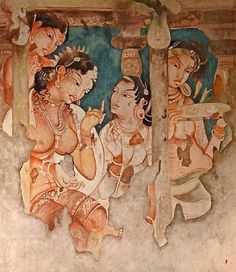
A painting from the Ajanta Caves depicting women with bare breasts, illustrating an aspect of attire in ancient art.
Late anthropologist and writer Tho. Paramasivan pointed out that surprisingly there is no evidence of tailoring in Tamil literature until the late 18th century. He also highlighted a unique aspect of ancient Tamil clothing—the practice of staining the borders of garments. This custom was not limited to women's sarees but also applied to men's dhotis(கரை வேட்டி), where the stained borders were considered valuable. Even today, this tradition persists, with Tamil Nadu silk sarees being renowned for their distinctive border stains.
Until the mid-eighteenth century, the concept of shirts and pants was largely unknown to the masses in Tamil Nadu. The upper-class citizens, who typically engaged in less physical labour, wore garments that reached below the knee or up to the ankles. In contrast, the majority of people, engaged in manual labour , dressed in garments that extended only to the knee. Those subjected to caste oppression were often required to wear a shoulder piece around their waist as a symbol of humility. Similarly, the custom of wearing undergarments was not prevalent among either men or women in ancient Tamil society. Ancient sculptures, including depictions of royal women, do not show women wearing bralettes, and the petticoats used today to support sarees were not in existence. There is no evidence in pre-Silappathikaaram Tamil literature of women wearing undergarments either, mentions Paramasivan in his book Ariyappadaadha Thamizhagam. The depiction of female idols wearing a bodice or bralette becomes evident only from the 9th century onwards, marking a gradual shift in artistic and cultural expressions of attire. On the contrary, significant evidence suggests that women adorned themselves with various accessories while often wearing minimal clothing.
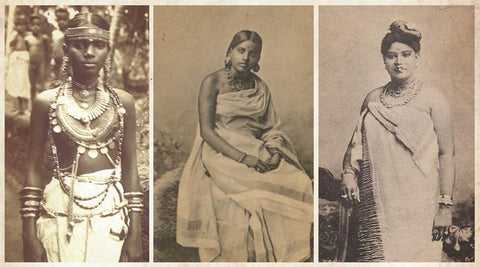
Women in various saree drapes pre-colonial era.
The custom of women wearing sarees in the present style began in Tamil Nadu during the 15th century, largely influenced by the Vijayanagara Empire's rule and the immigration of Telugu people into the region. These cultural shifts brought about significant changes in the lives and traditions of the Tamils, and consequently, Tamil clothing evolved. During this time, the traditional two-piece attire worn by women gradually transitioned into a single long piece, reflecting the blending of cultural practices. Prior to this period, the term "Pudaivai(புடைவை)” meaning saree referred to the long cloth worn by Jain monks.
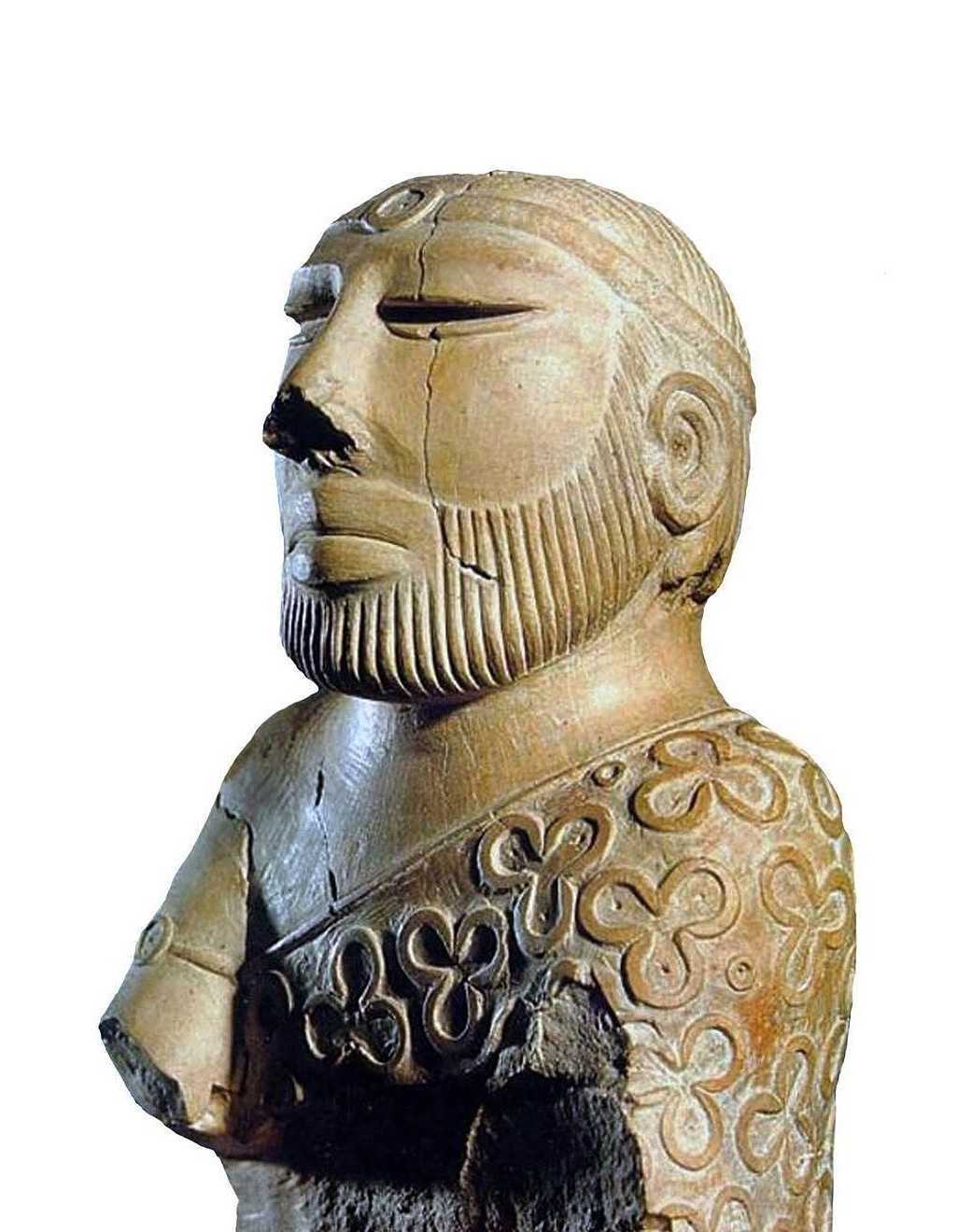
Statue of an Indus priest or nobleman, depicted with a cloth draped around his upper body, carved from steatite (soapstone), from Mohenjo-daro.
வெண்புடைவை மெய்சூழ்ந்து - பெரியபுராணம்
In his writings, Saekizhaar (சேக்கிழார்) mentions that Tirunavukkarasar (திருநாவுக்கரசர்), a prominent religious figure, left the Jain monastery "wearing a white saree." Even today, male monks in Jain temples are seen wrapping sarees around their bodies.
The blouse, as an essential part of Tamil women's attire, started gaining prominence during the Mughal period. This was due to cultural exchanges and influences, particularly through matrimonial alliances between Indian royal families and Mughal rulers. However, it was during the British colonial era that the blouse became a standardized garment in Tamil Nadu, as social and cultural norms continued to evolve.
The Sangam era provides glimpses into women-centric occupations, with widowed women, referred to as "Paruthi Pendir"(பருத்திப்பெண்டிர்) being employed in cotton weaving. This role highlights the societal structure that allowed women a degree of economic engagement. However, it remains uncertain whether this employment was empowering or a form of systemic discrimination, as the records predominantly reference widowed women in this work. This practice underscores how specific cultural and economic functions shaped gender roles within the ancient Tamil social fabric.
The evolution from simple drapes to the structured saree reflects broader changes in Tamil society—the influence of different dynasties, the impact of external cultures, and the development of new aesthetic and moral standards. It also reflects the textile industry's evolution, from hand-spinning and hand-weaving to mechanized production, which made a greater variety of fabrics available to more people.
Tamil Nadu's clothing traditions reveal a fascinating weave of cultural exchanges, social structures and evolving practices over centuries. From unstitched garments of the Sangam age to the draped sarees and tailored blouses of the later periods, these transformations reflect broader societal changes and external influences. The blending of indigenous practices with ideas brought by traders, empires and colonizers created a distinct identity, where every piece of fabric tells a story of adaptation and resilience. Today, these threads of history remain interwoven in Tamil Nadu’s traditional attire, symbolizing a heritage that continues to inspire and evolve in the modern world.