The Tamil Learning Challenge Schools Face Today
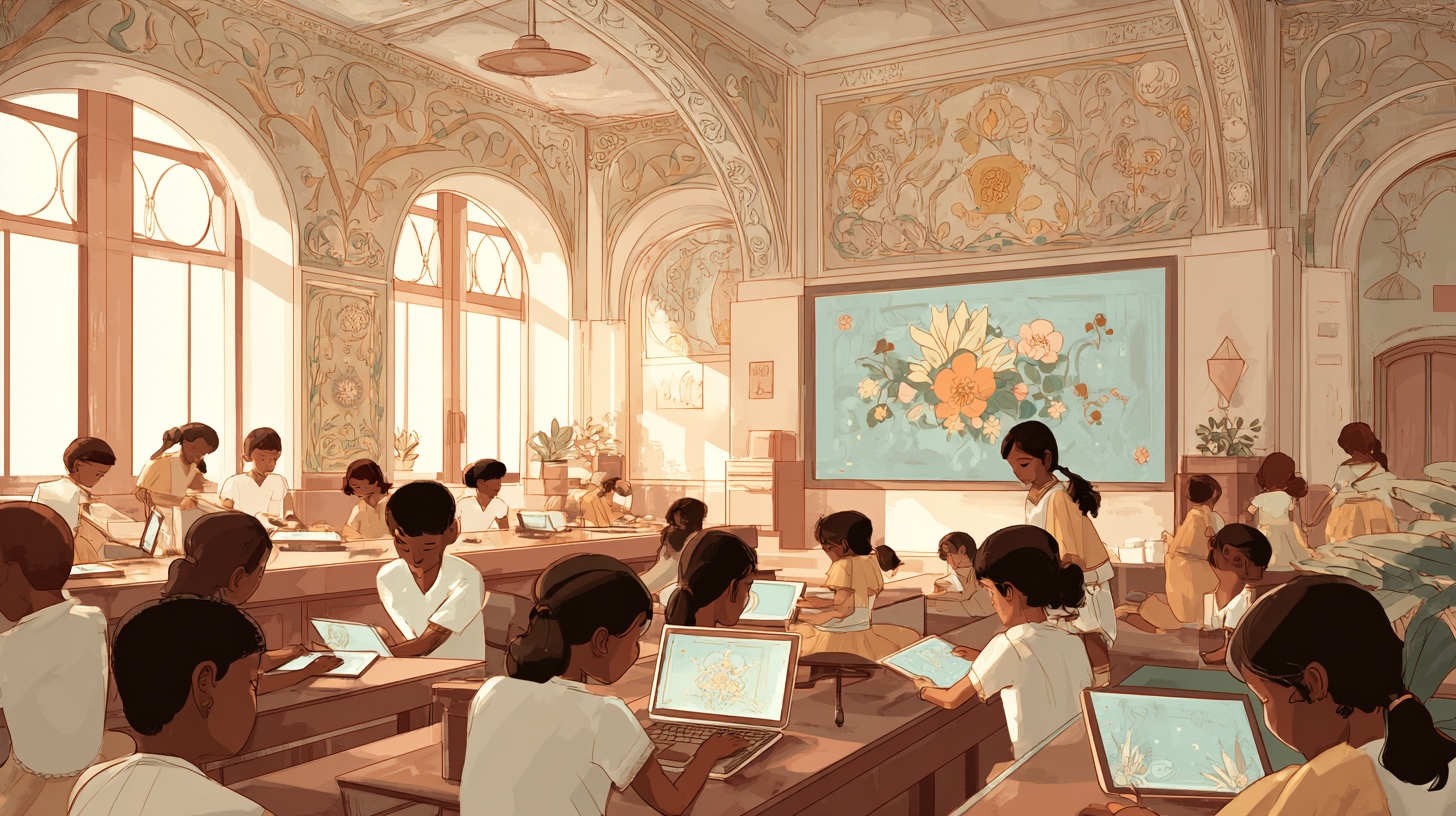
Your students walk into Tamil class carrying smartphones, accustomed to content that responds to them, adjusts to them, and keeps them engaged with the reliable cunning of a well-designed video game. Many Tamil classrooms, through no fault of their committed teachers, are still working with methods that would feel familiar to a student from fifty years ago. The gulf between the learning environment children inhabit outside school and the one they enter for Tamil class is, to put it gently, noticeable.
School principals and Tamil teachers across Tamil Nadu, Singapore, Malaysia, and diaspora communities worldwide face a version of the same question: how do you teach one of the world's oldest living languages to children who think in digital? And how do you do it without hollowing out the cultural richness that makes Tamil worth learning in the first place?
The answer that has begun to emerge, and that this article explores in some depth, is not a choice between tradition and technology. The most successful Tamil education programmes in 2026 are those that have found a way to do both at once: to use structured, research-based digital tools to make Tamil learning genuinely engaging, while keeping the language's literature, history, and cultural texture at the centre of every lesson. The students who come out of these classrooms do not just know Tamil. They care about it.
How Technology Is Changing Tamil Education in 2026
Digital tools in Tamil education have come a long way from the era of PDFs and grammar quizzes posted on school portals. What distinguishes the most effective platforms today is the sheer depth of curated, language-specific content they offer, content that has been built not by generic EdTech developers working from a brief, but by linguists, educators, and people who have spent careers thinking carefully about how Tamil works and how learners acquire it.
The shift this makes to the classroom experience is significant. When a student reads a graded Tamil story pitched precisely at their comprehension level and illustrated with cultural context they recognise, something different happens compared to slogging through a textbook chapter. When they sing a Tamil song that manages, with characteristic Tamil ingenuity, to explain photosynthesis through rhyme and rhythm, the vocabulary stays. When they play a game that tests not just their recall of words but their listening comprehension, observational skills, and writing, they are practising Tamil without feeling like they are practising Tamil. This is not a small thing.
Platforms like Thambaa Tamil Labs, developed by the Karky Tamil Academy under linguist and lyricist Dr. Madhan Karky and educator Nandini Karky, represent the kind of integrated digital ecosystem that Tamil education has needed. Rather than a single tool doing one thing adequately, they bring together multiple dimensions of language learning into a coherent whole, built around 16 levels of language proficiency that take students from their very first Tamil letters through to sophisticated engagement with classical texts.
The Power of Personalised Tamil Learning
One of the enduring frustrations of traditional Tamil instruction is that a class of thirty students will have wildly different starting points, and a single lesson aimed at the middle of the room inevitably loses the children at both ends. The student who already reads Tamil fluently sits bored while letters are drawn on the board. The student who has never seen the Tamil script before is overwhelmed before the second consonant.
Structured digital platforms address this by making levelled content genuinely available. Within Thambaa Tamil Labs, for instance, the Nooli module offers 1,650 books graded across levels, so a student working through the platform can always be reading something that is appropriately challenging rather than either trivially easy or discouragingly hard. Stories about personalities from around the world, graded in vocabulary and syntax to match the student's stage, mean that reading practice is also cultural broadening. This is what good heritage language pedagogy looks like in practice.
The same principle applies across the other modules. A student who finds the formal grammar of written Tamil intimidating can approach it through songs before encountering it on the page. A student who learns best by doing, by tapping, tracing, matching, and sorting, can spend more time in the game-based environment without being penalised for it. The content structure accommodates different learning paths rather than insisting on a single one.
Digital Tamil Classrooms That Feel Like Home
The most immediate delight of Thambaa Tamil Labs for students tends to be the variety. There are six modules in the platform, each addressing a different dimension of language learning, and each genuinely different in character from the others.
Nooli, which means books in Tamil, is the reading library at the heart of the system. Its 1,650 graded titles include stories of remarkable people from across the world, presented at increasing levels of linguistic complexity. This is not a collection of simplified text excerpts. It is a proper graded reader library, designed for the specific challenge of Tamil literacy development, and it grows with the student.
Paadal, the songs module, is where Tamil education reveals what it can do that no textbook can. With 360 poems and songs covering subjects as wide-ranging as thermodynamics, photosynthesis, and classical Tamil ethics, Paadal turns the rhythm and musicality of Tamil into a learning tool. The phonetic patterns of Tamil, its distinctive consonants, its vowel-heavy syllable structure, its poetic metres, are all far easier to internalise through song than through drill. Students who have sung their way through Paadal tend to have noticeably better pronunciation and a more natural relationship with Tamil prosody than those who have not.
Aadal, the games module, brings together 60 interactive activities designed to test the full range of language skills: verbal, listening, comprehension, writing, and observation. The important word here is test. These are not reward games layered over vocabulary lists; they are genuine exercises in language use, designed by people who understand what Tamil learners need to practise. Students who resist sitting with a grammar exercise will quite happily spend forty minutes on Aadal games that are exercising the same underlying skills.
Beyond Games: A Complete Tamil Learning Ecosystem
What distinguishes Thambaa Tamil Labs from a collection of standalone tools is its coherence as a complete learning ecosystem. The six modules work together, each reinforcing what the others have built, rather than existing as separate experiences with no relationship to one another.
The Payil module provides the structured course content that sits at the curriculum's centre. Where Nooli, Paadal, and Aadal offer rich content for exploration and practice, Payil provides the structured learning pathway that gives a teacher something to plan a term around. Combined with the Payil printed textbooks, which run from LKG through Level 5 (with Levels 6 to 12 currently in development), the digital Payil module gives schools a coherent, graded Tamil programme with both physical and digital components reinforcing each other.
Karuvi, the tools module, is something of a linguist's dream made accessible to school students. It offers a comprehensive suite of Tamil language utilities built on a vocabulary database of 1.5 million Tamil words spanning from Sangam-era classical literature to contemporary usage. Among its tools are a synonym finder, a Thirukkural portal that allows searching by number or theme, a rhyme finder (invaluable for creative writing lessons), a transliterator, a morphological analyser, a spell checker, and a number convertor, among others. This is not a toy vocabulary list; it is the kind of reference infrastructure that serious Tamil learning demands, and making it available to students within the learning platform is a genuine contribution to how Tamil can be taught.
Aazhi, the assessment module, completes the ecosystem by providing teachers with structured evaluation tools. Progress in Nooli, Paadal, Aadal, and Payil can all feed into a picture of where each student stands across the 16 proficiency levels the platform tracks. Assessment becomes a natural part of learning rather than a separate, anxious event at the end of term.
Supporting Teachers in the Digital Age
Any honest account of digital Tamil education has to acknowledge what teachers actually need from these platforms, which is not just content for students but genuine support for their own professional practice. Tamil teachers, particularly in community schools and smaller institutions, often carry very full loads: they are designing lessons, managing mixed-ability classes, handling administrative tasks, and trying to stay current with both the language and the pedagogy simultaneously.
The value of a platform like Thambaa Tamil Labs to a teacher is not that it replaces any of this, but that it significantly reduces the content-creation burden. A teacher who knows that 1,650 graded readers are available, organised by level, and that 60 games are ready to assign for consolidation practice, can spend their planning time on what technology cannot do: building cultural context, facilitating discussions, asking questions, telling stories, making the language feel alive and worth caring about. These are the things that keep students in Tamil education long-term, and they require a present, engaged teacher. Freeing teachers from time spent creating basic materials is a direct investment in that presence.
The professional development dimension also matters. Schools using Thambaa Tamil Labs gain access not just to student-facing content but to a curriculum framework, including Payil textbooks and structured course content, that reflects current thinking in Tamil language pedagogy. Teachers working within this framework absorb good pedagogical practice as they teach, which compounds over time into a stronger overall programme.
Global Tamil Education: Connecting Diaspora Schools
Tamil schools in Singapore, Malaysia, Canada, the UK, and the United States face a particular version of the digital Tamil education challenge. Their students hear Tamil at home and sometimes nowhere else; they arrive at Saturday school with spoken intuition but limited literacy; they are being taught by dedicated volunteers who may be fluent speakers but trained in other professions entirely. The stakes are also higher in one sense: for diaspora students, the Tamil classroom may be the only place in their entire week where the language is formally engaged with, and if that hour is dull or disconnected from their lives, they will simply stop coming.
Digital tools designed with content depth and cultural richness, rather than generic language-app mechanics, can transform what a Saturday school can offer. A Nooli graded reader about a Tamil scientist's life, or a Paadal song that makes Tamil prosody genuinely enjoyable, or an Aadal game that holds a twelve-year-old's attention for thirty minutes on a Saturday morning, is doing something that a photocopied worksheet cannot. The technology does not replace the warmth and cultural knowledge of a good community teacher; it gives that teacher better materials to work with.
For diaspora schools that want to use the Payil printed textbooks alongside the digital platform, the consistency between the two is a significant advantage. A student using Payil textbooks in Toronto and another using them in Chennai are working from the same linguistically sound curriculum framework, even if their cultural contexts differ. This kind of standardisation is exactly what diaspora Tamil education has historically lacked.
Measuring Success in Digital Tamil Learning
Schools that implement structured digital Tamil learning programmes want to know whether they are working, and they should. The measurement question is more interesting than it might appear, because the outcomes worth tracking in Tamil education go well beyond reading fluency scores.
Immediate language skill gains are of course trackable: reading accuracy, writing fluency, vocabulary breadth, and speaking confidence all respond to good instruction and can be assessed through the Aazhi module's tools and standard classroom observation. These matter and should be followed. But they are not the whole picture.
Student engagement is one of the most revealing indicators of programme quality. Schools using rich digital content consistently report that voluntary participation in Tamil activities increases: students spend time in Nooli or Aadal outside assigned sessions, ask to hear more Paadal songs, bring Tamil words into conversations. This kind of voluntary engagement predicts long-term retention of the language far better than test scores alone. A student who chooses Tamil in their free time is a student who will still speak it at thirty.
Cultural knowledge, often the most neglected axis of Tamil education assessment, can also be tracked meaningfully. Whether students can discuss Tamil festivals, recognise classical literature references, and situate the language in its historical context are all legitimate learning outcomes, and they connect directly to the cultural engagement that Thambaa Tamil Labs builds through its content choices. A graded reader about a Tamil mathematician is not just a language exercise; it is cultural education. Both dimensions count.
The Future of Tamil Education Technology
Digital Tamil education in 2026 is already a significant step beyond where it was five years ago. The content that the Karky Tamil Academy has built into Thambaa Tamil Labs, in terms of sheer quantity, linguistic rigour, and cultural thoughtfulness, represents years of careful work that is now available to schools at scale. And yet this is still the beginning of what technology can do for Tamil.
Voice recognition and speech analysis tools calibrated specifically for Tamil phonetics, which are quite different from those of English or Hindi and have historically been underserved by standard speech tools, could transform spoken Tamil practice. Immersive content that places Tamil learning in culturally authentic visual environments could extend what Nooli and Paadal already do. Adaptive pathways that respond dynamically to each student's progress across all six modules of Thambaa Tamil Labs could make the personalisation even more precise.
The most important commitment for any platform developing in this space is the one that the Karky Tamil Academy has already demonstrated: that technological sophistication and cultural authenticity are not competing values but complementary ones. The Thambaa Tamil Labs library did not reach 1.5 million words and 1,650 graded books by cutting corners on either front. Future developments will be most valuable when they hold to the same standard: tools that are genuinely impressive to use and genuinely faithful to the language they are serving.
Schools ready to bring this kind of programme into their classrooms can explore the full Thambaa Tamil Labs ecosystem and Payil curriculum at academy.karky.in.
Frequently Asked Questions
What is Thambaa Tamil Labs and how does it differ from other Tamil learning apps?
Thambaa Tamil Labs is a six-module digital learning platform developed by the Karky Tamil Academy, designed specifically for school-based Tamil instruction rather than casual individual learning. Its six modules, Nooli (graded books), Karuvi (language tools), Aadal (educational games), Paadal (songs and poems), Payil (structured courses), and Aazhi (assessments), work together as an integrated curriculum ecosystem rather than as isolated features. The platform is built on 16 proficiency levels and supports both Tamil Nadu school curricula and diaspora Saturday school programmes. What most distinguishes it from consumer language apps is the depth and rigour of its content: over 1,650 books, 360 songs, 60 games, and a 1.5-million-word reference database built from scholarly linguistic research.
Which age groups does Thambaa Tamil Labs serve?
The platform is designed to serve learners from LKG through to advanced levels, with the Payil textbook series currently covering LKG through Level 5 and Levels 6 to 12 in development. The 16-level proficiency framework accommodates the full range from early childhood literacy through to sophisticated engagement with Tamil literature and grammar. The content within each module, particularly the Nooli graded readers and Paadal songs, is designed to scale in complexity, so younger and older learners can both find material pitched at their level.
How does the Payil curriculum relate to Thambaa Tamil Labs?
Payil is both a module within Thambaa Tamil Labs and a broader curriculum framework that includes physical printed textbooks. The Payil textbooks, priced at INR 350 for LKG and UKG levels and INR 700 for Levels 1 through 5, provide the structured print component of the curriculum, while the digital Payil module within Thambaa Tamil Labs offers the corresponding online course content. Schools using both together benefit from a seamless connection between physical and digital learning, with the same linguistic sequencing and cultural content running through both. The full online course platform is also available independently at payil.karky.in.
Can diaspora Tamil schools outside India use Thambaa Tamil Labs?
Yes. The digital platform is accessible online and has been designed with the understanding that Tamil learners are distributed across the world. Saturday schools in the UK, Australia, Canada, the USA, Malaysia, Singapore, and South Africa can use Thambaa Tamil Labs and Payil textbooks as the basis for structured Tamil instruction. The content, particularly within Nooli and Paadal, travels well across cultural contexts precisely because it was built to engage with Tamil language and heritage rather than to assume a Tamil Nadu-specific setting. Schools interested in integrating the full programme can enquire through academy.karky.in.
Does using digital tools in Tamil education weaken cultural transmission?
This is a concern worth taking seriously rather than dismissing. The honest answer is that it depends entirely on which digital tools and how they are used. Generic language apps that treat Tamil as interchangeable with any other language, presenting it as a vocabulary list with audio buttons, do very little for cultural transmission and can actually flatten the richness of what Tamil is. Platforms like Thambaa Tamil Labs, by contrast, put cultural content at the centre: the Nooli books are stories drawn from Tamil and global heritage, the Paadal songs are composed with careful attention to Tamil prosody and metre, the Karuvi tools are built on the full vocabulary of classical and contemporary Tamil. Used well, these tools do not compete with cultural transmission; they are cultural transmission.
What does a school need to get started with Thambaa Tamil Labs?
Standard classroom technology, including tablets, computers, or interactive whiteboards, along with a reliable internet connection, is sufficient to access the platform. Schools adopting Thambaa Tamil Labs receive the curriculum framework, including structured lesson support through the Payil component, which significantly reduces the preparation burden on teachers. For schools new to structured digital Tamil instruction, the Karky Tamil Academy team can provide guidance on implementation. Full details and partnership enquiries are available at academy.karky.in.